
If you manage a warehouse in South Africa, your racking system is one of your highest-risk assets. Damage to uprights, overloaded beams, or missing safety components can result in serious injury, stock loss, and operational downtime.
This guide outlines what warehouse racking inspections involve, how they align with South African safety requirements, and how to ensure your facility remains compliant and operational.
A warehouse racking inspection is a structured, systematic assessment of a pallet racking system to confirm that it is safe, compliant, and fit for purpose. The objective is to identify risks early and prevent structural failure.
A professional inspection focuses on:
While internal checks play an important role in day-to-day safety, independent inspections by qualified specialists such as Nolwazi provide an objective, compliance-aligned assessment.
South African legislation may not always refer to “racking inspections” explicitly, but the responsibility is clear.
Under the Occupational Health and Safety Act, employers are required to provide and maintain a safe working environment. This includes ensuring that all storage systems are structurally sound and properly maintained.
Insurance providers increasingly require documented proof of inspections and maintenance. If a racking system fails and there is no inspection record, businesses carry full liability for damages, injuries, and operational losses.
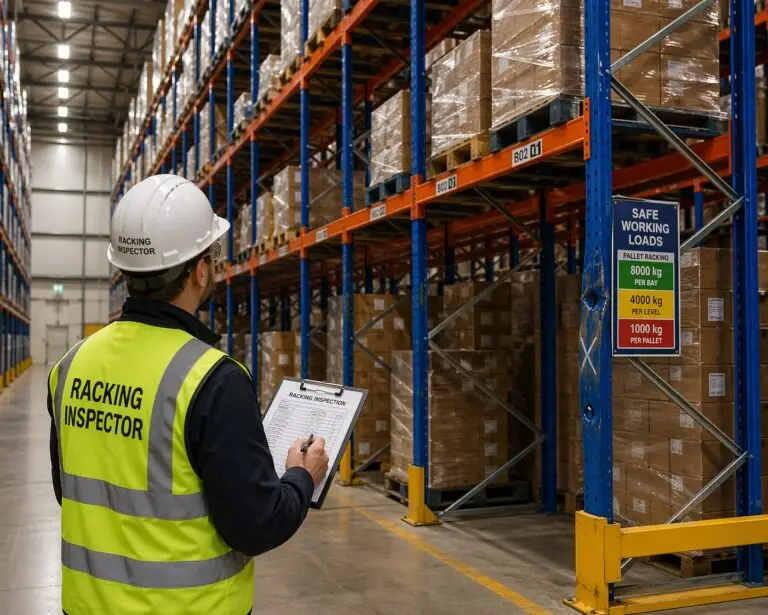
An effective inspection strategy operates on multiple levels:
Conducted by warehouse staff to identify visible damage such as bent uprights, dislodged beams, or unstable frames.
More detailed, checklist-driven inspections performed by a supervisor or safety officer, with proper documentation.
A formal, comprehensive assessment conducted by a qualified racking specialist. Nolwazi provides annual inspections aligned with recognised industry standards, including SEMA guidelines, supported by detailed reporting.
Professional inspections assess both visible damage and underlying structural risks.
Common issues include:
Each issue is classified by severity, with clear recommendations for repair, replacement, or immediate offloading where necessary.
Neglecting inspections introduces significant operational and legal risk.
Structural failure can result in partial or complete collapse, placing employees in danger and disrupting operations. Damaged racking compromises stock integrity and leads to financial loss.
From a compliance perspective, failure to maintain safe systems exposes businesses to liability under the OHS Act, including potential fines, shutdowns, or legal action.
Insurance claims related to racking failure are frequently rejected where no documented inspection history exists.
A professional racking inspection goes beyond a basic visual check. It is a comprehensive evaluation of the entire system.
This typically includes:
Nolwazi supports businesses with structured inspections, detailed reporting, and practical guidance to ensure compliance is not only achieved but maintained.
Warehouse racking inspections are not optional from a risk management perspective. They are a critical part of maintaining a safe, compliant, and efficient operation.
Regular inspections reduce risk, support compliance, and ensure operational continuity.
If your facility has not undergone a formal racking inspection in the past 12 months, it is time to act.
Contact Nolwazi to schedule a professional racking inspection and ensure your warehouse operates with confidence and compliance.